Do you need an air quality monitor? Honestly — not everyone does. A monitor won't clean your air; it only measures it. But for the right person it turns invisible problems into a number you can act on: when to run the purifier, when to open a window, and whether your air is actually improving. Whether it's worth it comes down to your home, your health, and how much you want to see your air versus just quietly clean it. Here's how to decide.
Key takeaways
- A monitor measures, it doesn't clean. It has no effect on your air by itself — its whole value is telling you when and how to act.
- The best fits are people with a reason to watch: allergy and asthma households, heavy cooks, wildfire-region homes, new or renovated spaces that off-gas, and stuffy, poorly ventilated rooms.
- A cheap PM2.5 monitor is enough for most, since tracking relative changes is what actually drives decisions.
- It pairs naturally with a purifier — the monitor is the gauge, the purifier is the engine.
What does an air quality monitor actually do?
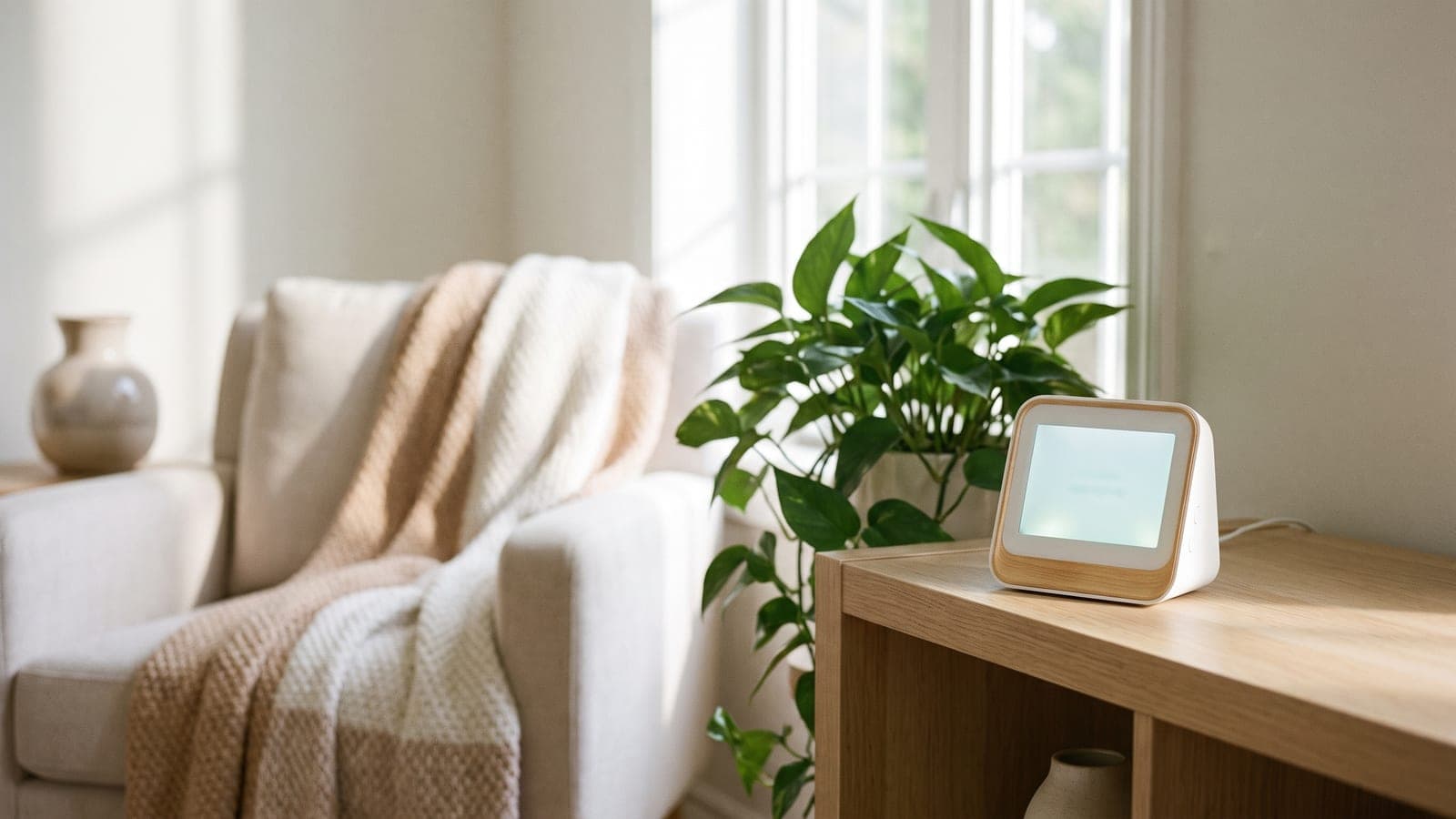
A monitor is a sensor, not a cleaner. It samples the air and reports numbers — most importantly PM2.5 (fine particles), and often CO2, VOCs, humidity, and temperature — on a display or in an app. That's the whole job: it makes your air visible. On its own it won't trap a particle or clear an odor. What it changes is your behavior. Instead of guessing whether the air is bad, you see the reading climb when you cook, spot outdoor smoke leaking in, and watch levels fall after the purifier does its work. If you want the full breakdown of each reading, see what an air quality monitor measures.
Who genuinely benefits from one?
A monitor earns its keep when you have a specific reason to watch your air. The clearest cases:
- Allergy and asthma households. Seeing particle and pollen levels rise tells you when to run the purifier and close windows. It helps you manage the environment — though it's a data tool, not a medical device, so a diagnosed condition is still a conversation for your doctor.
- People who cook a lot. High-heat stovetop cooking sends PM2.5 spiking fast. A monitor shows you just how much, so you know when to crank the purifier or the range hood.
- Wildfire and high-pollution regions. When outdoor air turns hazardous, a monitor tells you whether your sealed-up, purifier-running defense is actually holding indoor levels down.
- New or newly renovated homes. Fresh paint, new furniture, cabinetry, and flooring off-gas VOCs and formaldehyde for weeks. A monitor shows the levels dropping as the space airs out.
- Stuffy, poorly ventilated rooms. A CO2 reading is the best gauge of ventilation — invaluable in a closed bedroom overnight or a crowded home office where the air goes stale.
Who can skip it?
Plenty of people don't need one. If your air is generally fine, you don't have allergies or asthma in the house, you're not in a smoke-prone area, and your home isn't newly built or renovated, a monitor is more curiosity than necessity. The same goes if you already run a purifier with a built-in air-quality light and you're happy to trust its auto mode — that indicator already covers the "is the air bad right now?" question at a basic level. And a monitor changes nothing on its own: if you're not prepared to act on the readings — run the purifier, open a window, cut the source — the number is just trivia. There's no shame in deciding the information isn't worth the spend.
How does a monitor pair with an air purifier?
This is where a monitor really shines: it closes the loop with your purifier. The purifier cleans; the monitor tells you when and how hard to run it, and then confirms it's working. See PM2.5 spike, switch to high; watch it fall, ease back off. It also answers a question purifier owners ask all the time — is this thing actually doing anything? A monitor shows the before-and-after in real numbers, which is exactly the approach in our guide on how to tell if your air purifier is working. Think of the pair as gauge and engine: the engine does the work, but the gauge is how you drive it well.
Cheap or premium — how much should you spend?
| Tier | Roughly | What you get | Best for |
|---|---|---|---|
| Budget | ~$40–70 | PM2.5 and a couple of extras; instant reading or basic app | Most people who just want to see particles |
| Mid | ~$100–150 | PM2.5, CO2, VOCs, and a strong app with history and trends | Those who want to understand patterns over time |
| Premium | ~$250–300 | Broad metrics, sometimes radon or outdoor AQI, full logging | Specific needs like radon, or a do-everything home tracker |
The honest guidance: a cheap PM2.5 monitor is enough for most homes. Budget sensors track relative changes well — they clearly show the reading rise when you cook and fall after the purifier runs — even if they aren't laboratory-precise, and relative change is what actually drives your decisions. Step up to mid or premium only for a real reason: you want long-term app history and trends, extra metrics like CO2 for ventilation, or the rare specialty of radon detection.
The bottom line
You need an air quality monitor if you have something specific to watch — allergies, heavy cooking, wildfire smoke, a new home that's off-gassing, or stuffy rooms — and you're willing to act on what it shows. If none of that fits, you can comfortably skip it, or lean on your purifier's built-in air-quality light instead. If you do want one, a budget PM2.5 model covers most needs; our roundup of the best air quality monitors matches real devices to each situation, from a cheap instant reader to a full-featured tracker.
Frequently asked questions
Does an air quality monitor clean the air?
No — a monitor only measures your air, it doesn't clean it. It won't remove a single particle. Its value is information: it tells you when the air is bad, when to run your purifier harder, and whether your setup is working. Think of it as the gauge, not the engine. For actual cleaning you still need a purifier.
Is a cheap air quality monitor good enough?
For most people, yes. A budget PM2.5 monitor reliably shows the direction and size of a change — the reading climbing while you cook, then dropping after the purifier runs — even if it isn't lab-precise. That relative feedback is what drives everyday decisions. Spend up only if you need extra metrics like radon or CO2, or long-term app history and trends.
Do I need a monitor if I already have an air purifier?
You don't strictly need one, but they pair naturally. A purifier cleans; a monitor tells you when and how hard to run it, and confirms it's actually working. Many purifiers have a built-in air-quality light, which covers the basics. A standalone monitor adds a real number and, often, history — useful if you want to fine-tune rather than just trust the auto mode.
Will a monitor help with my allergies or asthma?
It can help you manage your environment by showing when particle or pollen levels rise so you can run the purifier and close windows in response. That's genuinely useful. But a monitor is a data tool, not a medical device — if you're managing a diagnosed condition like asthma, the readings are no substitute for advice from your doctor.
What's the one thing a monitor should measure?
PM2.5. It's the metric most tied to health effects and the one that tells you whether to run your purifier. Nice-to-haves like CO2 (ventilation), VOCs (off-gassing), and radon matter to specific people, but PM2.5 is the near-universal must-have. Make sure any monitor you consider tracks it.