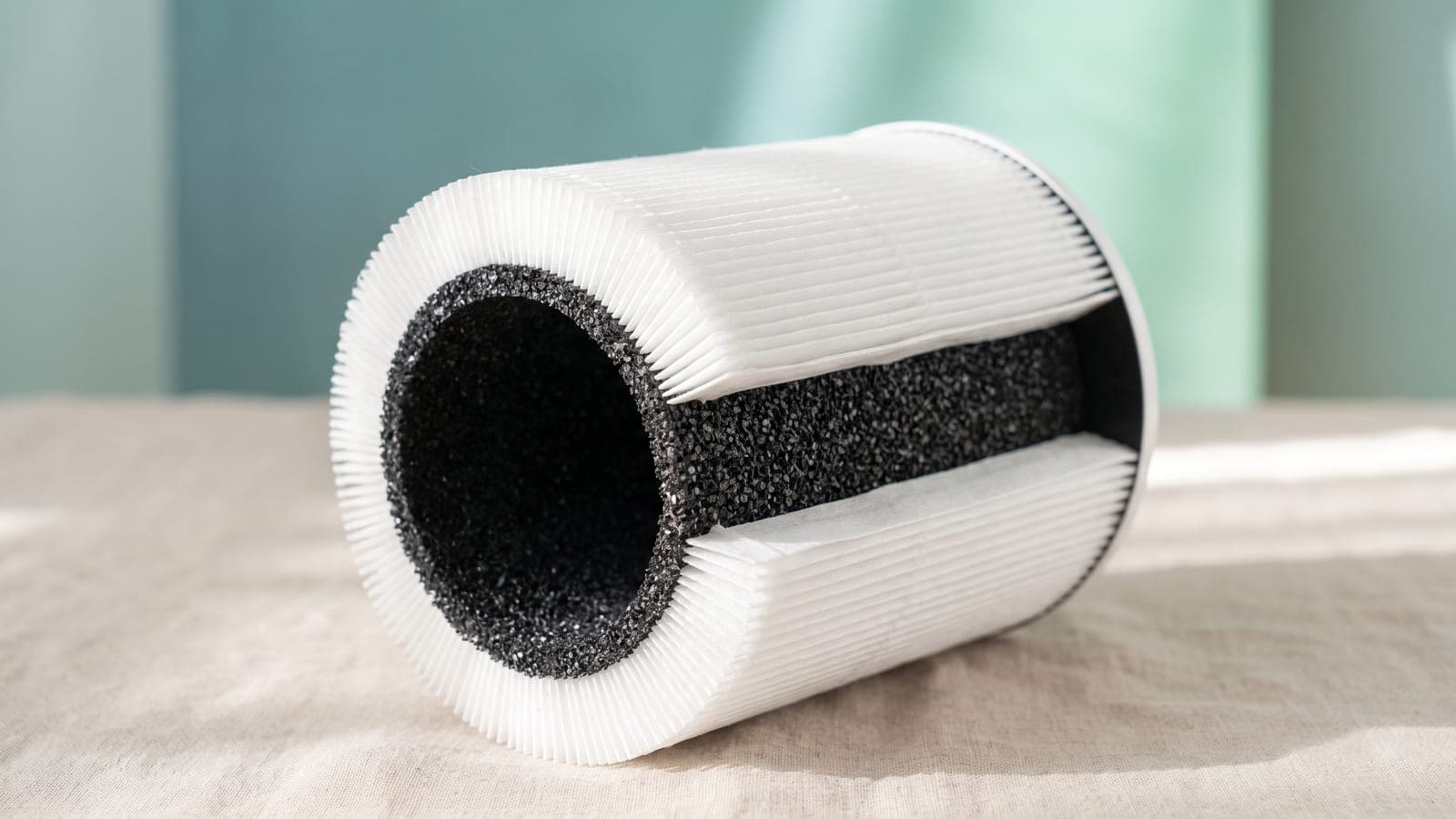
An activated carbon air filter is the part of a purifier that handles what a HEPA filter can't: gases, odors, and VOCs. Where HEPA physically traps solid particles like dust and pollen, activated carbon uses a process called adsorption to pull gas-phase molecules — cooking smells, smoke odor, paint fumes, off-gassing chemicals — out of the air and hold them onto its enormous internal surface area. If you care about smells and not just particles, the carbon stage is the half of the filtration story most shoppers underestimate.
Key takeaways
- HEPA catches particles; carbon adsorbs gases. They solve different problems, which is why serious purifiers include both.
- Activated carbon works by adsorption — gas molecules stick to a vast network of tiny internal pores.
- More carbon by weight means more capacity and a longer life before it saturates.
- Thin, carbon-coated filters do very little for real odor or VOC control.
- Carbon saturates and must be replaced — a full filter can even release odors back into the room.
What does an activated carbon filter actually do?
It removes things you smell rather than things you'd see under a microscope. A HEPA filter is a mechanical net for solid particles; it does essentially nothing for gases. Activated carbon covers that gap. It targets:
- Odors — cooking smells, pet odor, garbage, lingering smoke smell.
- VOCs (volatile organic compounds) — off-gassing from paint, new furniture, flooring, adhesives, and cleaning products.
- Smoke gases — the gaseous fraction of wildfire and cigarette smoke that HEPA leaves behind.
That's why the two filters are a team. On a smoky day, HEPA strips the particulate haze while carbon tackles the acrid smell. Buy a purifier for odor control and skip the carbon spec, and you'll be disappointed no matter how good the HEPA is.
How does activated carbon work?
Through adsorption — with a "d," not absorption. The carbon is "activated" by processing that riddles it with a staggering network of microscopic pores, giving a small amount of material an enormous internal surface area. As air flows through, gas molecules adhere to the walls of those pores and stay there.
The key consequence is that carbon has a finite capacity. Every pore that fills is one that can't grab another molecule. Two things drive how well a carbon filter performs: how much carbon there is (more surface area, more capacity) and contact time (air moving slowly enough through a thick enough bed to let molecules land). A whisper-thin layer of carbon simply doesn't offer enough of either.
Why does more carbon mean better performance?
Because capacity scales with mass. A carbon bed measured in pounds has far more pore surface area — and therefore far more room to hold gas molecules — than a filter with a light carbon coating. More carbon means both better removal at any moment and a longer useful life before the bed saturates.
Here's the practical split you'll see across purifiers:
| Light / carbon-coated filter | Heavy carbon bed (pounds of pellets) | |
|---|---|---|
| Carbon amount | A dusting or thin sheet | Several pounds of granular/pelletized carbon |
| Odor & VOC removal | Minor, short-lived | Strong and sustained |
| Useful life for gases | Weeks to a few months | Many months to a year+ |
| Best for | Faint, occasional smells | Cooking, smoke, VOCs, chemical odors |
| Typical units | Budget purifiers | Premium gas-focused purifiers |
The pattern is consistent: if gases and odors are a real concern, weight of carbon is the spec that predicts results.
Why don't thin carbon-coated filters help much?
Because there isn't enough material to matter. Many budget purifiers wrap the HEPA in a carbon-impregnated fabric or a thin honeycomb sheet. It's genuinely activated carbon, so it's not a lie — but the total mass is a fraction of an ounce, and it saturates quickly.
That's fine for a faint, occasional smell in a small bedroom. It is not enough for a smoky kitchen, a fresh coat of paint, or persistent pet odor. When a spec sheet touts "HEPA + activated carbon" but never states the amount of carbon, that near-silence usually tells you it's the thin kind. For light-duty needs it's acceptable; for real gas control, look for a unit that quantifies its carbon.
How often does activated carbon need replacing?
More often than you'd hope, and on its own schedule. Because carbon fills up, a saturated filter stops adsorbing — and worse, a badly overloaded bed can start releasing captured odors back into the room, especially as temperature and humidity shift. That's the opposite of what you bought it for.
Life span depends on carbon volume and how hard it's working. A thin coated filter might be spent in a few months; a multi-pound bed can run a year or more. Carbon also usually wears out faster than the HEPA stage, so on combined filters you're often replacing both together at the carbon's pace. One clever exception: the Winix 5500-2 uses a washable carbon pre-filter you rinse and reuse for basic odor duty, which trims ongoing cost — handy, though not a substitute for a large bed when VOCs are the target.
Which of our picks have serious carbon versus thin carbon?
This is where the honest spread shows up. At the top end, purifiers built for gases carry pounds of carbon. The AirDoctor AD5500i pairs its filtration with a dual carbon/VOC gas stage, and the IQAir HealthPro Plus uses a large V5-Cell gas and odor cartridge — both are genuine choices when chemical fumes and strong odors are the problem, and both are premium, sold-direct machines priced accordingly.
Mainstream mid-range units — the Coway Airmega AP-1512HH Mighty, Winix 5500-2, and Levoit Core 300S — include real but modest carbon that handles everyday cooking and pet smells without pretending to be an industrial gas scrubber. That's the right tradeoff for most homes. Just match the carbon to your actual need: everyday odors are fine with a mid-range unit; heavy VOC or chemical concerns justify stepping up to a big dedicated carbon bed. Our premium purifier comparison digs into the two heaviest gas-tacklers head to head.
The bottom line and your next step
Activated carbon is the unsung half of good air purification: HEPA for the particles, carbon for the smells and gases. The single spec that predicts whether it'll actually work is the amount of carbon — thin coatings do little, pounds of pellets do a lot — and remember it saturates, so it needs replacing on its own schedule.
If VOCs, chemical fumes, or stubborn odors are what's driving your search, start with our roundup of the best air purifiers for VOCs, where carbon capacity is the headline requirement rather than an afterthought.
Frequently asked questions
What does an activated carbon air filter remove?
Gases, odors, and volatile organic compounds (VOCs) — things a HEPA filter can't touch. That includes cooking smells, smoke odor, paint and cleaning fumes, and off-gassing from new furniture. Carbon works on molecules in gas form; HEPA works on solid particles. Most good purifiers use both.
How long does an activated carbon filter last?
It depends heavily on how much carbon there is and how much gas it's absorbing. A thin, carbon-dusted filter may fade in a few months, while several pounds of pelletized carbon can last a year or more. Once carbon is saturated it stops adsorbing and can even release odors back, so it needs replacing on schedule.
Is more activated carbon actually better?
For gases and odors, yes. Carbon works by adsorption onto its internal surface area, so more carbon by weight means more capacity and a longer useful life before saturation. A purifier with several pounds of real carbon will handle VOCs far better and longer than one with a thin carbon-coated sheet.
Does activated carbon remove VOCs and formaldehyde?
It captures many VOCs and odor molecules well, and larger carbon beds handle them better and longer. Formaldehyde is a small, stubborn molecule that plain carbon adsorbs less efficiently, which is why heavy-duty gas purifiers use specially treated media. For serious VOC concerns, prioritize a unit with a large, dedicated carbon or gas stage.
Can I reuse or wash an activated carbon filter?
Mostly no. Once carbon is saturated its pores are full and washing won't restore capacity. The exception is a few units, like the Winix 5500-2, that use a washable carbon pre-filter designed to be rinsed and reused for basic odor duty. For most purifiers, plan to replace the carbon on the maker's schedule.