In a 50-pint vs 70-pint dehumidifier comparison, the two numbers usually come from different tests, so the bigger one isn't necessarily the bigger machine. Since 2019, home dehumidifiers have been rated under a DOE test at 65°F and 60% relative humidity. The older industry ratings used 80°F and 60%, and warmer air gives up more water, so the same machine scores lower today. That's largely why the 70-pint models that used to top the shelf gave way to 50-pint ones: the test got colder, not the machines weaker. Today, a "70-pint" label mostly turns up on crawl-space units that still quote the warmer figure.
Key takeaways
- Ratings changed in 2019. ENERGY STAR says the new procedure tests portable dehumidifiers at 65°F rather than 80°F.
- The drop is large. ENERGY STAR's approximate conversion puts an old 70-pint rating at 40 to 45 pints and an old 50-pint at about 30.
- Saturation figures aren't capacity ratings. Waykar's "80 pints" is measured at 95°F and 90% humidity; under the DOE test, ENERGY STAR certifies the unit at 24.93.
- Always check the conditions next to the number. A pint figure without a temperature and humidity attached tells you very little.
- Size in DOE pints. The dehumidifier size calculator uses them, so compare its answer with the 65°F figure.
What changed in the 2019 dehumidifier test?
The Department of Energy moved the capacity test for portable dehumidifiers from 80°F to 65°F, both at 60% relative humidity, and added a new efficiency figure. ENERGY STAR's testing and capacity explainer says all new dehumidifiers have been rated with an IEF value since June 2019, and that from early 2020 shoppers could see models looking much like earlier ones but carrying lower capacity ratings.
IEF stands for integrated energy factor: liters of water removed per kWh of electricity. Higher is more efficient. Relative humidity, or RH, is how much water the air holds compared with the most it could hold at that temperature.
Cooler air holds less water, so the machine has less to pull out during the test. Same compressor, same coils, smaller number.
How much lower is a DOE rating than an old 80°F rating?
Expect today's rating to land around 60% to 70% of the old one, often called the AHAM rating after the Association of Home Appliance Manufacturers test it came from. ENERGY STAR's approximate table, which it says will vary by model, maps an old 50-pint portable to about 30 pints and an old 70-pint to 40 to 45.
Makers that publish both figures fall in the same band:
- Waykar: 35 pints at 80°F and 24.49 at 65°F, both at 60% RH, per the JD025C-80 manual. That's about 70%.
- AlorAir Sentinel HDi65S: 55 pints at 80°F and 36.33 under the DOE test, per ENERGY STAR. About 66%.
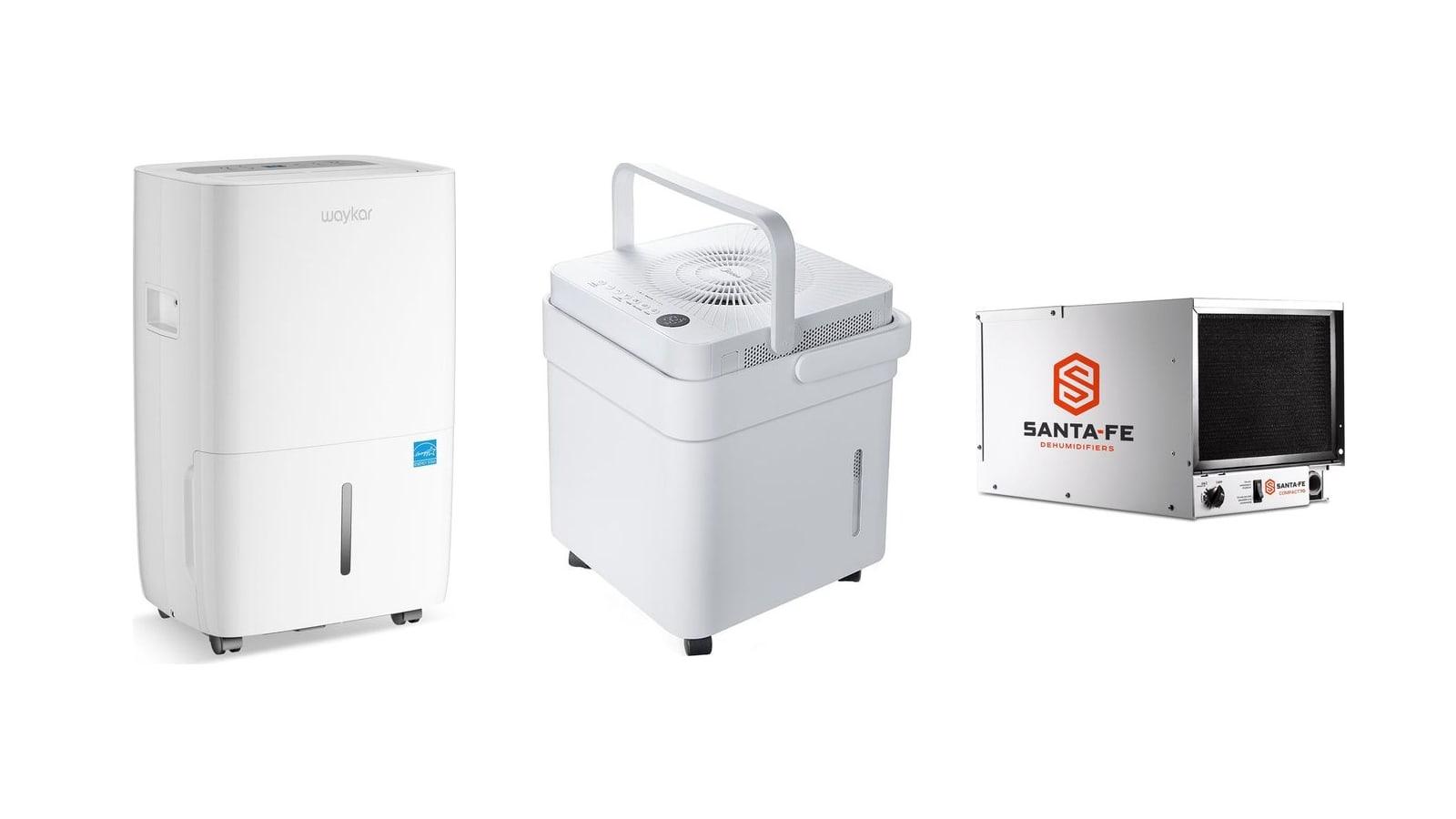
- Santa Fe Compact70: 70 pints at 80°F and 43.7 at 65°F, both Santa Fe's figures. About 62%.
So the popular rule of thumb that an old 70-pint equals a new 50-pint is, by ENERGY STAR's numbers, a little generous to the old units. A current 50-pint DOE model is at least as much machine as the 70-pinters it replaced, on paper.
What does a saturation figure like "80 pints" mean?
It's how much a dehumidifier removes in hot, nearly saturated air, conditions few homes ever reach. The figure is real for those conditions, but it's useless for comparing against a DOE rating.
Waykar's JD025CE-80 is the clearest case. It's sold as an "80-pint" unit, with retailer listings claiming up to 5,000 sq ft. The manual for the earlier JD025C-80 lays out the whole ladder: 24.49 pints at 65°F and 60%, 35 at 80°F and 60%, 60 at 86°F and 80%, and 80 at 95°F and 90%. ENERGY STAR certifies the JD025CE-80 at 24.93 pints a day. The number in the name is roughly three times the one you should compare.
AlorAir quotes a saturation figure too, 120 pints at 90°F and 90% for the HDi65S, but it sits alongside its 80°F rating instead of in the product name. That's the honest way to do it: one more data point, clearly labeled.
Why do crawl space makers still quote 80°F or saturation numbers?
The makers don't say why, but the pattern is clear: the 80°F figure is the common currency in that market, and some crawl-space units have no ENERGY STAR listing to fall back on. The Santa Fe Compact70 and AprilAire E070 aren't on ENERGY STAR's list, and both lead with 70 pints at 80°F and 60% RH. AlorAir leads with 55 pints at the same condition, even though ENERGY STAR lists the HDi65S.
Whole-home units are a separate category again. ENERGY STAR's explainer says DOE sets separate minimum efficiencies for portable and whole-home dehumidifiers because they operate under different conditions, and AprilAire quotes 53 pints for the E070 at 73°F and 60%, the condition DOE uses for whole-home units.
None of this is dishonest, as long as the conditions are printed next to the number. The trap is comparing a crawl-space unit's 80°F figure with a basement portable's 65°F figure. Within crawl-space units, comparing 80°F numbers with each other is fair. Our best crawl space dehumidifiers list shows both figures for each pick.
How do real models compare under each test?
Reading across a row shows how much the number swings with temperature and humidity; reading down a column is the only fair comparison.
| Model | 65°F, 60% RH (DOE portable) | 73°F, 60% RH (DOE whole-home) | 80°F, 60% RH (AHAM) | Hot, humid figure |
|---|---|---|---|---|
| Waykar JD025CE-80 | 24.93 (ENERGY STAR); 24.49 in the JD025C-80 manual | Not published | 35 (JD025C-80 manual) | 60 at 86°F/80%; 80 at 95°F/90% |
| Midea Cube 50-Pint with Pump | 50 (DOE) | Not published | Not published | Not published |
| AlorAir Sentinel HDi65S | 36.33 (ENERGY STAR) | Not published | 55 | 120 at 90°F/90% |
| Santa Fe Compact70 | 43.7 (Santa Fe) | Not published | 70 | Not published |
| AprilAire E070 | Not published | 53 (AprilAire) | 70 | Not published |
All figures are pints per day, from the maker's documentation or ENERGY STAR's listing as noted. "Not published" means we didn't find a figure for that condition in the sources behind our reviews.
The Honeywell Home A65D whole-home unit shows the same curve from another angle: Resideo lists 34 pints at 60°F, 48 at 70°F and 65 to 67 at 80°F, and ENERGY STAR certifies it at 52.09 under the whole-home test.
How do you read a dehumidifier spec sheet?
Find the test conditions first, then the number. A few habits make it quick:
- Look for the temperature and humidity. "65°F/60%" or a mention of the DOE or the 2019 standard means it's comparable with other home units. "80°F/60%" or "AHAM" means the older scale.
- Check ENERGY STAR's list. A certified model has a DOE capacity and IEF on record, which settles the question when the box is vague.
- Treat big square-footage claims with suspicion. Waykar's 5,000 sq ft claim sits on a 25-pint DOE unit.
- Compare IEF for running costs. The 50-pint ENERGY STAR portables in our catalog cluster at 2.01 liters per kWh; the Waykar is at 1.70.
- Check what's not a capacity spec. Bucket size, pump lift and operating temperature range all matter, but none of them changes the pint rating.
What should you do with this when shopping?
Work out your need in DOE pints, then compare only DOE-condition figures. The dehumidifier size calculator gives its answer in DOE pints, so the 50 on a Midea Cube is a direct match, while for a crawl-space unit you'd use AlorAir's 36.33 or Santa Fe's 43.7 rather than the headline.
ENERGY STAR's dehumidifier guidance suggests 20 to 30 pints a day for small to medium spaces that are slightly to moderately damp, and 50 or more for large or wet ones, and says oversizing beats undersizing. For a large or wet basement, that points to a 50-pint DOE unit; our best dehumidifiers list sorts the options.
Whatever you buy, aim for the room, not the machine. The EPA recommends keeping indoor humidity below 60%, ideally between 30% and 50%, and its guide to mold and moisture suggests a humidity meter, about $10 to $50, to check. A dehumidifier that hits 45% is the right size, whatever the box says.
Frequently asked questions
Is a 70-pint dehumidifier better than a 50-pint one?
Only if both numbers come from the same test. A 70-pint label today usually means a crawl-space or contractor unit quoting the older 80°F figure, while a 50-pint home unit is rated at 65°F. By ENERGY STAR's approximate conversion, an old 70-pint rating is about 40 to 45 pints under the current test.
What does IEF mean on a dehumidifier?
IEF is the integrated energy factor, measured in liters of water removed per kWh of electricity. All new dehumidifiers have carried it since June 2019, per ENERGY STAR. Higher is better: the 50-pint ENERGY STAR portables in our catalog sit at 2.01, the Waykar JD025CE-80 at 1.70, and the Honeywell Home A65D whole-home unit at 2.23.
Did dehumidifiers get weaker after the 2019 rule change?
No. The machines didn't shrink; the test got colder, and colder air gives up less water. ENERGY STAR notes that from early 2020 shoppers could see models that look like earlier ones but carry lower capacity ratings.
Why does my dehumidifier collect less water than its rating?
The rating is measured at fixed temperature and humidity, and a cooler or drier room yields less. Resideo's figures for the Honeywell Home A65D show the effect: 65 to 67 pints a day at 80°F, 48 at 70°F and 34 at 60°F. A room already close to your humidity setting has less left to remove, too.
How big a dehumidifier does a damp basement need?
ENERGY STAR suggests 20 to 30 pints a day for small to medium spaces that are slightly to moderately damp, and up to 50 or more for large or wet spaces, adding that it's better to oversize than undersize. Those figures are in today's DOE pints.
Are pint ratings per day or per hour?
Per day. Dehumidifier capacity is the number of pints of water removed in 24 hours under the test conditions. A pint is 16 fluid ounces, so a 50-pint rating is a little over 6 gallons a day.