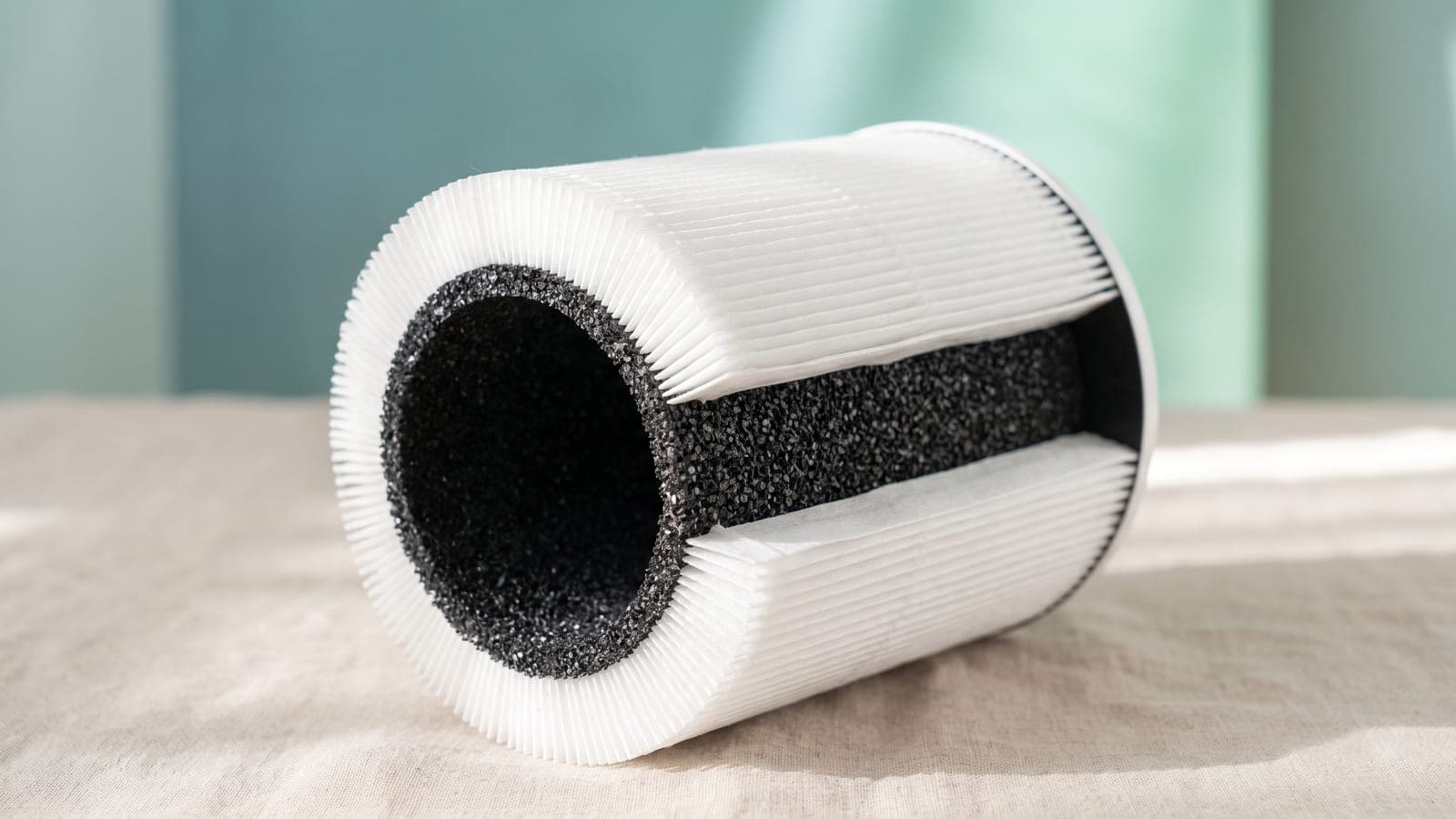
Air purifiers remove part of the cigarette smell, not all of it. A purifier with True HEPA and a heavy activated-carbon filter strips smoke particles and a good share of the odor gases out of the air, so a room smells noticeably fresher within an hour or two. What it can't touch is the residue that has already soaked into walls, carpet, curtains and furniture, and that residue keeps releasing the stale smell back into the air for months.
So the honest answer depends on where the smell is coming from: fresh smoke in the air, or old smoke in the room itself.
Why the smell outlasts the smoke
Tobacco smoke is a mix of fine particles and gases, and the two leave the air at very different speeds. In a chamber study by Lawrence Berkeley National Laboratory researchers, summarized in a 2016 Tobacco Control paper, fine particles fell by 65% two hours after smoking and by 98% after 18 hours. Nicotine and most related amines were no longer detectable in the air after just two hours.
That nicotine didn't vanish. It stuck to the walls and furnishings, which the 2016 paper describes as "massive adsorption to surfaces." Smoke particles settle into dust and carpet, and the semivolatile chemicals coat drywall, ceiling tiles, mattresses and fabric, then slowly drift back out. That stored layer is what researchers call thirdhand smoke, and it is the reason a room can look clear and still smell like an ashtray.
A purifier works only on air that passes through it. It catches the particles still floating and adsorbs some of the gas as it is re-released, but it can't pull residue off a wall.
How long the residue sticks around
Longer than most people expect. San Diego State University researchers measured 100 smokers' homes before the occupants moved out, then measured again after non-smokers moved in. Even after homes sat empty for about two months and were cleaned and prepared for the new tenants, dust and surfaces carried more nicotine than former non-smoker homes, and the new residents had more nicotine on their fingers.
A second study by the same group followed 90 smokers who quit. Nicotine on surfaces dropped within the first week, but nicotine and a tobacco-specific carcinogen in house dust stayed near their original levels, and homes were still polluted six months later. Berkeley Lab chemists have also shown that nicotine on indoor surfaces reacts with nitrous acid, a gas mainly given off by unvented gas appliances, to form new carcinogenic nitrosamines.
The practical point: if a smoker lived in the home for years, expect the smell to return every time the heat comes on or the humidity rises, no matter how good the purifier is.
What a purifier can do, in three common situations
Someone still smokes indoors. A purifier sized for the room and running on a high speed during and after each cigarette will cut the haze and blunt the smell, and that's worth having. It won't make the air safe. The CDC is blunt that there is no safe level of secondhand smoke and that air purifiers, fans and open windows do not get rid of it. Smoking in a closed bedroom doesn't protect the rest of the house either, because smoke spreads through doorways, wall gaps and ducts.
Smoke drifts in from a neighbor or another room. This is where a purifier earns its keep. The source is intermittent and outside your walls, so a carbon-heavy unit in the affected room can keep up with what seeps in. Seal the gaps first: weatherstrip the shared door, put foam gaskets behind outlet covers on the shared wall, and caulk around pipes. Then run the purifier on auto or a mid speed, and on high at the times the smell usually arrives.
You moved into a former smoker's home or rented a room that was smoked in. The purifier is a stopgap here. It makes the place livable while you clean, but the residue is the source, and the source has to come out.
Getting the residue out
Work from the biggest reservoirs down:
- Soft furnishings. Carpet padding, curtains, mattresses and upholstered furniture hold the most. Wash everything washable, have carpets professionally hot-water extracted, and accept that heavily smoked carpet and pad sometimes need replacing.
- Walls and ceilings. Wash them with a degreasing cleaner before painting. Paint applied straight over nicotine film tends to let the yellow stain and the smell bleed through, which is why decorators seal smoked walls with a stain-blocking primer first.
- Hard surfaces and inside cabinets. Thirdhand smoke gets into closed drawers and closets too, so wipe the insides, not just the doors.
- The HVAC system. Swap the furnace filter after cleaning, because it has been collecting smoke-laden dust from every room.
Skip the ozone generator. These machines are sold for smoke odor, but the EPA advises avoiding air cleaners that intentionally produce ozone because it irritates the lungs; our page on ionizer and ozone purifier safety covers the details.
How to choose and run a purifier for smoke odor
Carbon weight matters more than the HEPA grade. The EPA's guide to home air cleaners says activated carbon can be effective against gases "provided that there is a large amount of material used in the filter," and notes there is no standard rating for gas removal the way CADR rates particles. In practice, look for granular carbon in a separate panel or bed rather than a thin carbon-dusted sheet. Our activated carbon explainer shows how to tell them apart.
Size it with some headroom. On the site's sizing rule (smoke CADR × 1.55, about 4.8 air changes an hour), a 12×15 ft bedroom of 180 sq ft needs at least 116 CFM of smoke CADR, and a 350 sq ft living room needs about 226 CFM. Smoke is a strong, repeated source, so pick a unit rated for a room a size larger than yours; the room size calculator does the math for odd shapes and tall ceilings.
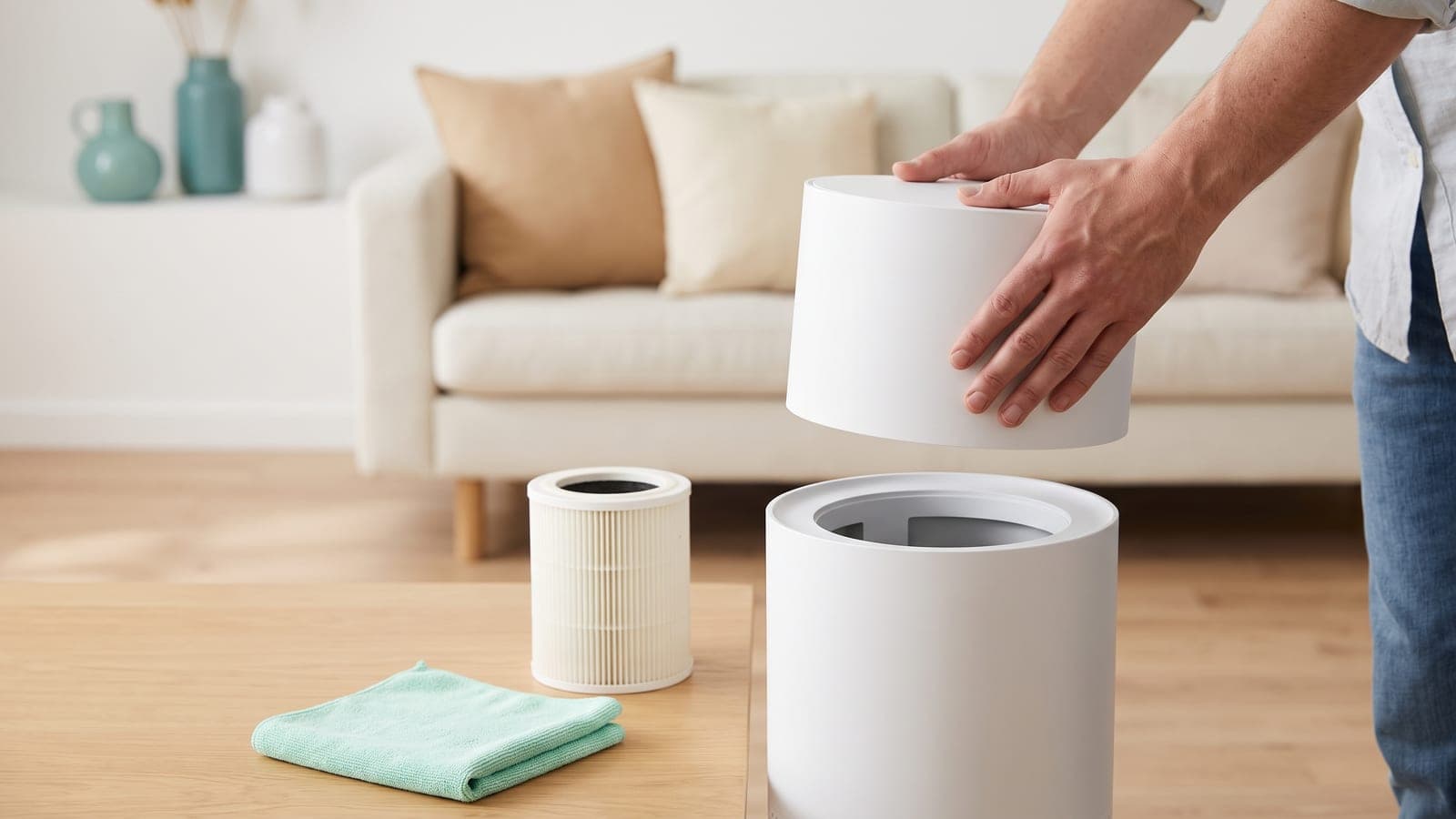
Expect to change the carbon early. Spent carbon stops adsorbing, and you'll notice the smell creeping back before any filter light comes on. When that happens, replace the carbon rather than waiting for the timer.
Put it between the smoke and the rest of the home. Near the doorway of the room where smoking happens, or against the shared wall the smell comes through, it catches odor before it spreads.
What to buy
For a serious, daily smoke problem in a large room, the AirDoctor AD5500i is the strongest option in our catalog, with a 556 CFM smoke CADR (about 862 sq ft) and a dedicated carbon/VOC stage. The IQAir HealthPro Plus carries the biggest gas filter, a V5-Cell that pairs carbon with alumina, for a little more money up front. For smoke drifting in from next door, the Winix 5530 gives you a granular carbon panel and 253 CFM (about 392 sq ft) for around $200, and the Winix 5500-2 trades some carbon capacity for a washable carbon pre-filter that keeps filter spending down.
The full ranking, with three-year filter costs, is on our best air purifiers for cigarette smoke page. Whichever you choose, treat it as the second half of the fix. Cleaning the surfaces, or smoking outside, is the first.
Frequently asked questions
Will a HEPA-only air purifier get rid of cigarette smell?
It will clear the visible haze and the fine particles, and the room will smell a little less sharp because some odor rides on those particles. The stale-tobacco smell itself is mostly gas and semivolatile chemicals, which pass straight through a HEPA sheet. For the smell, the machine needs a real activated-carbon stage, and the more carbon by weight the longer it keeps working.
How long does cigarette smoke smell last in a room?
The smoke itself hangs in the air for hours; the CDC notes that smoke from a single cigarette can stay in a room that long. The smell lasts far longer because nicotine and other compounds stick to walls, carpet and upholstery and slowly release back into the air. Researchers found homes still contaminated months after the smoking stopped, so in a long-time smoker's home the odor can persist until the surfaces are cleaned or replaced.
Can an air purifier make it safe to smoke indoors around kids?
No. The CDC says there is no safe level of secondhand smoke and that air purifiers, fans and open windows do not get rid of it. Nicotine residue also settles on surfaces, toys, skin and clothing, where children pick it up by touch. The only real protection is a home where nobody smokes indoors.
Will an air purifier stop smoke coming from a neighbor's apartment?
It can lower what reaches you, but it won't stop it. Smoke travels between units through gaps around pipes, outlets and shared ventilation, so sealing those gaps and talking to the landlord about the source does more than any machine. Run a carbon-heavy purifier in the room nearest the leak, on a higher speed during the hours the neighbor usually smokes.
Do ozone machines remove cigarette smell?
Ozone generators are sold for smoke odor, but the EPA advises avoiding air cleaners that intentionally produce ozone because ozone is a lung irritant. They are not a safe choice for a room people or pets are living in. Cleaning the surfaces and running a carbon-plus-HEPA purifier is the safer route.