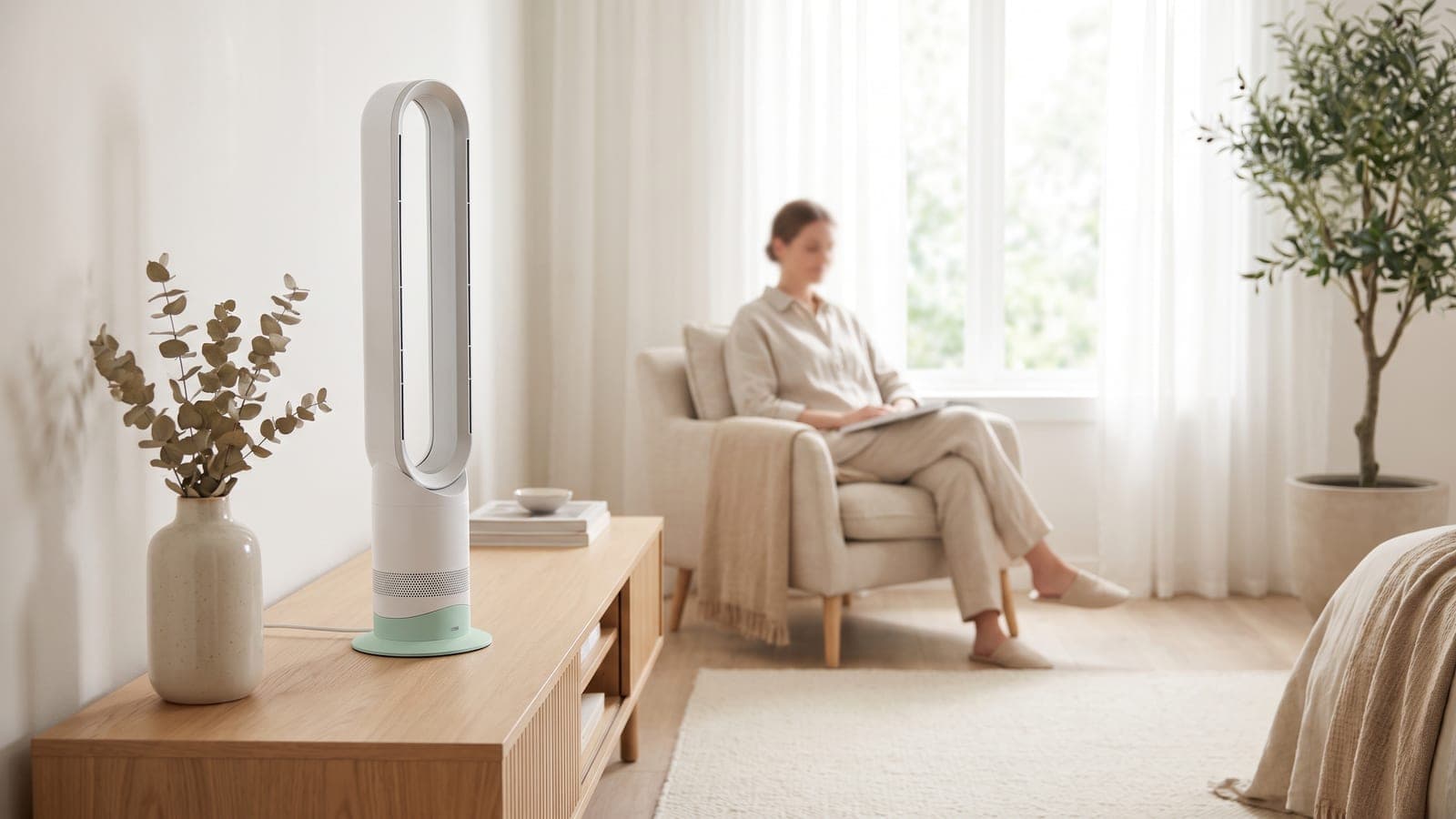
Few air purifiers turn heads like a Dyson. The bladeless tower is a genuine design object, it doubles as a cooling fan, and the MyDyson app puts a live air-quality readout, schedules, filter alerts, and remote control on your phone. If you want a purifier that looks the part and gives you data to play with, Dyson makes a compelling case. It's a gadget you'll actually enjoy owning.
The honest part of these Dyson air purifier reviews is the value question. Dyson does not publish an AHAM CADR figure, so you can't compare its clean-air output to a Coway or Winix on the standardized number the rest of the industry uses. The filtration is real, but you're buying the fan, the app, and the design as much as the clean air. This hub covers the model we carry, the Purifier Cool PC1, which replaced the TP07 in Dyson's US store, and who it's genuinely right for.
What Dyson is known for
Dyson's signature is design plus dual function. The bladeless "Air Multiplier" tower is instantly recognizable, and it isn't just a purifier — it's a cooling fan too, projecting a strong stream of filtered air across a room. That two-in-one nature is a big part of the appeal: one attractive device that cleans the air year-round and cools you in summer.
The other standout is the app and sensor experience. Dyson's purifiers carry onboard air-quality sensors and pair with the MyDyson app, which shows the room's air quality, runs schedules, warns when the filter is due, and reports what the machine has captured. Alexa, Google Assistant and Siri can control it too. For people who like to see what's happening to their air, it's close to owning an air-quality monitor built into the purifier. What Dyson doesn't do is publish a standardized AHAM CADR rating, which is the one number that would let you compare its raw clean-air output head-to-head with cheaper rivals.
Dyson Purifier Cool PC1: design, fan, and data
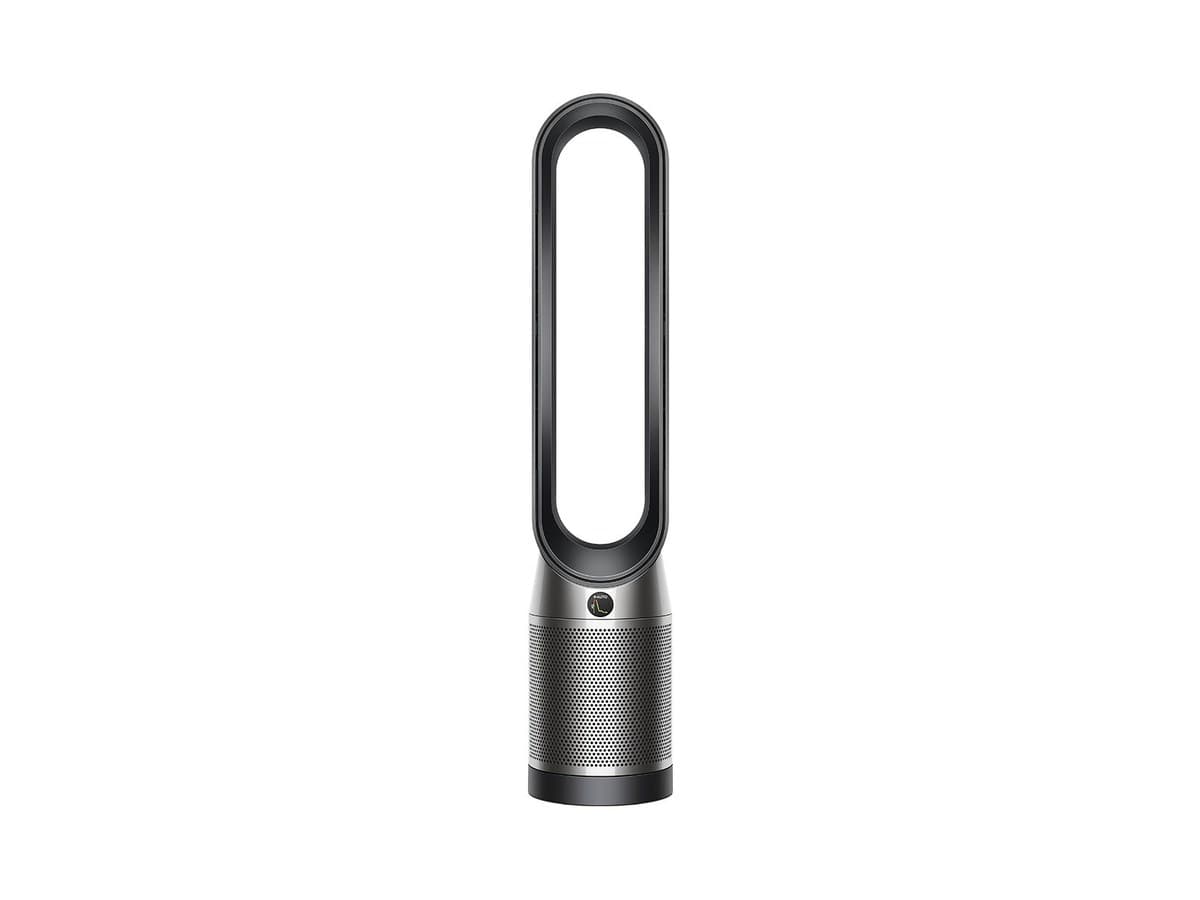
The Dyson Purifier Cool PC1 is Dyson's current purifying fan and the successor to the TP07, which Dyson's US store no longer sells. It runs a sealed 360-degree Glass HEPA H13 filter with activated carbon for odors and gases in one combined cartridge, and the whole machine is sealed so air doesn't bypass it. The fan side has 10 speeds and 350 degrees of oscillation, and it cools only (no heat). It stands 41.3 inches tall on an 8.7-inch base and weighs 10.4 lb. The filter costs $79.99 and lasts about 12 months, and Dyson sells the PC1 for $399.99 (list $549.99) with a 2-year warranty. Amazon doesn't sell it directly, so the buy button goes to Dyson.
Here's where honesty matters. Dyson tests with its own in-house whole-room method rather than submitting the PC1 for AHAM Verifide CADR certification, and it publishes no noise or wattage figures either. So there's no CADR to line up against a Coway or Winix and no decibel rating to check against a bedroom. That doesn't mean the filtration is weak, since the sealed H13 is legitimate, but you are trusting Dyson's own testing instead of a standardized figure. Our CADR explainer covers why that comparable number matters. Over three years the PC1 comes to about $640 in purchase and filters ($399.99 plus three $79.99 filters), before electricity. Buy it for the fan, the design, and the app, not because it's the best measured value.
Is Dyson worth it?
Yes, for a specific buyer. If you want one attractive device that purifies and cools, you like having air-quality readings on your phone, and the design genuinely appeals to you, the PC1 does all three. The price cut helps: at $399.99 it costs $50 to $150 less than the TP07 did, which narrows the premium you pay for the fan and the looks. If you also want formaldehyde destruction and nitrogen dioxide capture, Dyson's step-up Purifier Cool PC2 De-NOx adds both, at about $700 on Amazon.
But if your single goal is the most clean air per dollar, the Dyson is not the smart pick, and we won't pretend otherwise. Without a published AHAM CADR you can't confirm its output against the competition. For about $300 the Levoit Core 600S posts 391 CFM of smoke CADR, enough for about 606 sq ft, and the $230 to $270 Coway Airmega Mighty2 covers a 372 sq ft room with a 19 dB floor. Before you commit, compare it honestly with the value leaders: see our Dyson vs Coway and Dyson vs Levoit breakdowns. And remember the universal caveat: any purifier cleans airborne particles and, with carbon, some gases and odors, but it won't fix a moisture or mold source and it isn't a medical device. For asthma or allergies, treat it as one tool and talk to a doctor.
This is a research-based review — our analysis draws on manufacturer specifications, manuals, warranty terms, and verified owner feedback rather than our own hands-on testing, and we note where a detail couldn't be confirmed. How we review
Every Dysonmodel we've reviewed
Dyson
Dyson Purifier Cool PC1
Best design + cooling fan
Dyson's current purifying fan: sealed HEPA H13 and carbon filtration, a bladeless cooling fan, auto mode, and app control.
- $400–$550
Dyson comparisons, filter guides and fixes
Frequently asked questions
Are Dyson air purifiers worth the price?
It depends on what you're buying. If you want a purifier that doubles as a bladeless cooling fan, has a good app with air-quality data, and looks like a design object, the Purifier Cool PC1 delivers, and at $399.99 from Dyson it costs less than the TP07 it replaced. If your only goal is the most clean air per dollar, it isn't the best value: Dyson doesn't publish an AHAM CADR, and AHAM-rated purifiers at the same price or less give you a verified clean-air number.
Why doesn't Dyson publish a CADR rating?
Dyson uses its own in-house testing (its 'POLAR' whole-room method) rather than submitting units for AHAM Verifide CADR certification. That means you can't directly compare a Dyson to a Coway or Winix on the standardized clean-air-delivery number most of the industry uses. It's not proof the filtration is bad — the sealed HEPA is real — but it does make apples-to-apples value comparison harder.
Does the Dyson PC1 have a HEPA filter?
Yes. The Purifier Cool PC1 uses one combined filter: a 360-degree Glass HEPA H13 layer, which Dyson says captures 99.97% of particles as small as 0.3 microns, wrapped with activated carbon for odors and gases including VOCs. Dyson seals the whole machine so air can't slip around the filter. Filtration quality isn't the knock on Dyson; the knock is the lack of a published, comparable CADR.
Is a Dyson purifier good for a large room?
Dyson doesn't give the PC1 an AHAM CADR or an AHAM room size, so there is no standard way to say how large a room it can keep clean. The fan will push air across a big room, but moving air and filtering enough of it are different jobs. For a large room, an AHAM-rated unit such as the Levoit Core 600S (391 CFM smoke, about 606 sq ft) costs less and comes with a number you can check.
Should I buy a Dyson or a Coway/Levoit for clean air?
For pure clean-air value, a Coway or Levoit typically wins — they publish CADR, cost less, and feed cheaper filters. Buy the Dyson if you specifically want the bladeless fan, the app and sensor data, and the design, and you're happy to pay a premium for them. It's a great multi-purpose gadget, just not the clean-air-per-dollar champion.