CADR stands for Clean Air Delivery Rate, and it's the single most useful number on an air purifier's box. It tells you how much genuinely clean air the machine produces every minute, measured in CFM (cubic feet per minute) by an independent lab. If you only learn one spec before you buy, learn this one — it's the honest measure of how fast a purifier can actually clean your room.
Key takeaways
- CADR = how much clean air a purifier delivers per minute, rated in CFM by AHAM, the industry testing body.
- There are three CADR numbers — smoke, dust, and pollen. Smoke is the hardest test, so shop by the smoke number.
- CFM alone is just airflow; CADR is filtered airflow. A noisy fan can move lots of air while cleaning little of it.
- Match CADR to your room using AHAM's rule of thumb: at least two-thirds of the square footage for everyday air.
What does CADR actually measure?
CADR measures the volume of particle-free air a purifier delivers each minute. Picture a sealed test chamber filled with a known amount of a pollutant. The purifier runs, a meter tracks how fast the particle count drops, and that decline is converted into a clean-air rate in CFM. A unit rated at 200 CFM is, in effect, producing 200 cubic feet of clean air every minute.
The number is defined and verified by AHAM — the Association of Home Appliance Manufacturers — through its AHAM Verifide program. Because an outside lab runs the test to a fixed standard, a CADR from one brand means the same thing as a CADR from another. That's what makes it the fairest way to compare two purifiers.
Why are there three CADR numbers — smoke, dust, and pollen?
AHAM doesn't test one generic "dirt." It tests three particle sizes, because a filter's job gets harder as particles get smaller:
| CADR type | Particle size (approx.) | What it stands in for |
|---|---|---|
| Smoke | Smallest (~0.09–1 micron) | Wildfire and cooking smoke, fine soot |
| Dust | Medium (~0.5–3 microns) | Household dust, some mold spores |
| Pollen | Largest (~5–11 microns) | Pollen, pet dander, larger allergens |
Smoke particles are the smallest and the toughest to capture, so the smoke CADR is almost always the lowest of the three — and the best one to judge a purifier by. If a unit handles smoke well, it handles the easier, larger particles comfortably too. When a listing shows only one CADR without saying which, assume it's the most flattering (pollen) and dig for the smoke figure.
How is CADR different from CFM?
This trips up a lot of shoppers because CADR is reported in CFM. Here's the distinction:
- CFM is raw airflow — how many cubic feet of air the fan pushes per minute, filtered or not.
- CADR is the clean slice of that airflow — how much of the air coming out is actually free of particles.
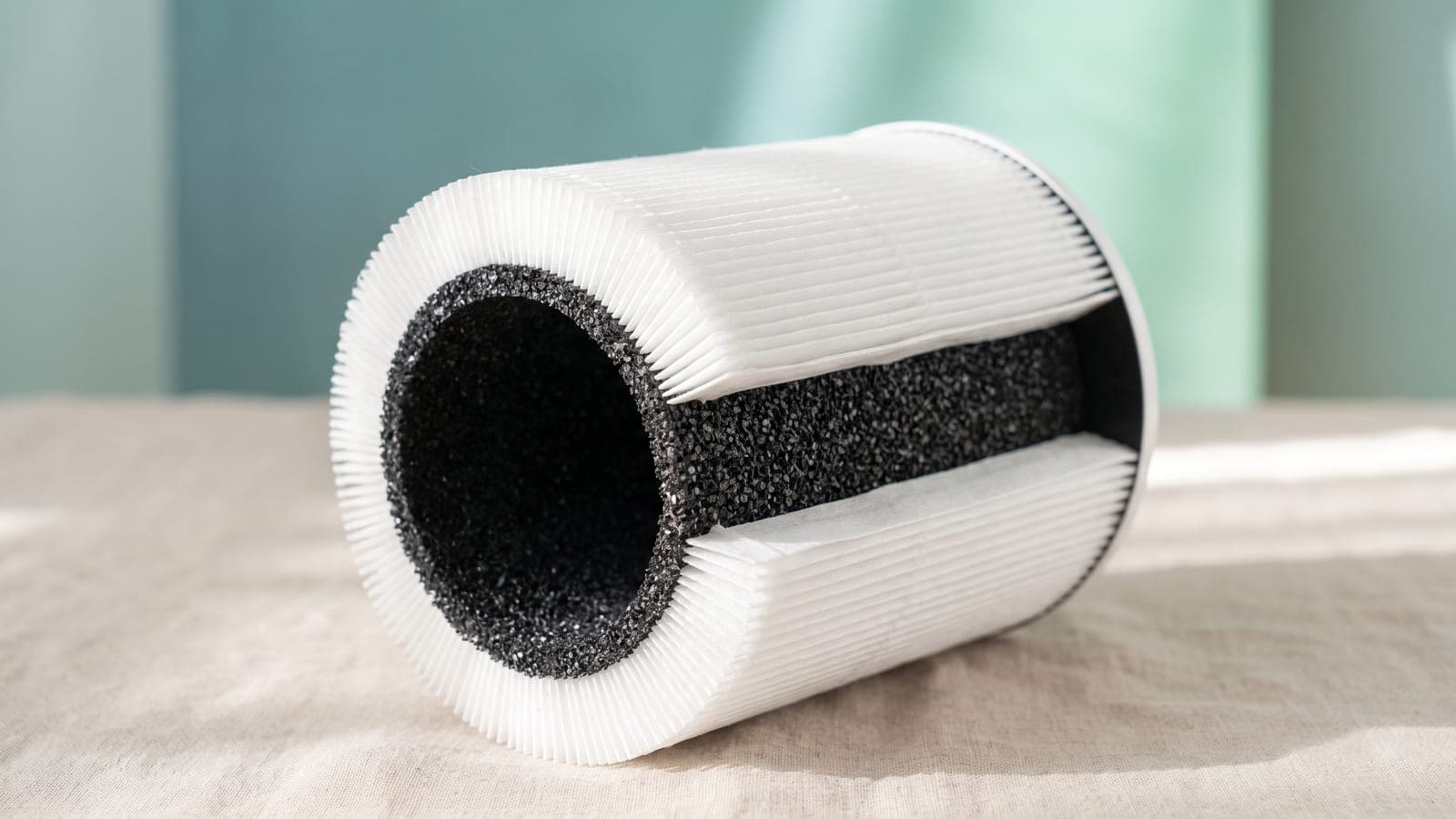
A purifier could move 250 CFM of air but, with a mediocre or poorly sealed filter, deliver a CADR of only 150. The other 100 CFM slips through carrying particles with it. This is exactly why a genuine, well-sealed True HEPA filter matters: it's what turns airflow into clean-air delivery. High CFM with low CADR is a fan with a weak filter.
What CADR do I need for my room?
AHAM publishes a simple rule of thumb known as the two-thirds rule: your purifier's smoke or dust CADR should be at least two-thirds of the room's square footage for everyday air. A 150-square-foot bedroom wants a CADR of about 100; a 300-square-foot living room wants about 200.
For wildfire smoke or heavy pollution, size up — AHAM suggests a smoke CADR roughly equal to the room's square footage, about 50% more clean-air power. That extra headroom lets the purifier keep pace when the air outside is bad.
To skip the mental math, the air purifier room size calculator turns your dimensions into a target CADR, with a wildfire toggle built in.
Why does "covers up to 1,500 sq ft" mean so little?
Coverage claims are where marketing gets slippery. A "covers up to X square feet" number is only meaningful if you know how many times per hour it cleans that space — and manufacturers rarely say. Many big coverage claims quietly assume just one air change per hour: technically the purifier touches all the air, but slowly enough that dust and pollen keep building up faster than they're removed.
Allergy and asthma guidance generally points to four to five air changes per hour. A purifier advertised for 1,500 square feet at one air change might only be doing a real job in 300 to 400 square feet. CADR sidesteps the guesswork because it's an absolute clean-air rate, not a room estimate. To see how many air changes a specific model delivers in your room, run it through the air changes per hour calculator.
How do I use CADR to compare two purifiers?
Line the units up on their smoke CADR first — that's the apples-to-apples number. Then sanity-check three things:
- Does the CADR clear the two-thirds rule for your room? If not, it's underpowered no matter how good it looks.
- Is there a verified AHAM figure, or just a manufacturer claim? Verified numbers carry more weight. You can confirm a listing through AHAM's directory at ahamverifide.org.
- What does it cost to run at that CADR? Higher output can mean more noise and power on the top speed — a big-CADR unit run gently is quieter than a small one maxed out.
Get those three right and you've done the hard part of buying an air purifier. CADR is the number that separates a machine that actually cleans your room from one that just hums in the corner.
Frequently asked questions
What does CADR stand for?
CADR stands for Clean Air Delivery Rate. It's a measure of how much filtered, clean air an air purifier produces, expressed in cubic feet per minute (CFM). The higher the CADR, the more clean air the unit delivers each minute.
What is a good CADR number?
It depends on your room. AHAM's rule of thumb is a smoke or dust CADR of at least two-thirds of the room's square footage for everyday air, and roughly equal to the square footage for wildfire smoke. A 150-square-foot bedroom, for example, wants a CADR of about 100 or more.
Why are there three CADR numbers?
AHAM tests each purifier against three particle sizes — smoke (the smallest), dust (medium), and pollen (largest). You get a separate CADR for each. Smoke is the toughest test, so the smoke number is usually the one to shop by.
Is CADR the same as CFM?
They share a unit but mean different things. CFM is cubic feet per minute of airflow. CADR is the amount of that airflow that is actually clean — filtered air delivered per minute. A purifier can move a lot of air (high CFM) while cleaning less of it (lower CADR).
Do all air purifiers list a CADR?
No. CADR testing is voluntary and run by AHAM, so many models — especially inexpensive or imported ones — skip it. A missing CADR isn't proof a unit is bad, but a verified CADR is the most trustworthy way to compare purifiers head to head.